
Creating Joyful Mathematics Experiences:
Reflections from the June 2026 AIMS Convening
Expanding our understanding of what rigorous math learning requires
 Convene
Joy is not just about a feeling of being happy, but about driving engagement in a way that can be rigorous — and in a way that is a precursor or necessary precondition for equity. It means creating the conditions that help students meet high expectations, develop positive mathematical identities, and come to know the joy of doing mathematics. That is a design challenge AIMS teams are taking up together.”
Britte Haugan Cheng
AIMS Collaboratory Facilitation Team
The AIMS Collaboratory gathered in June in Chicago for our ninth biannual convening. The theme: “Creating Joyful Mathematics Experiences.”
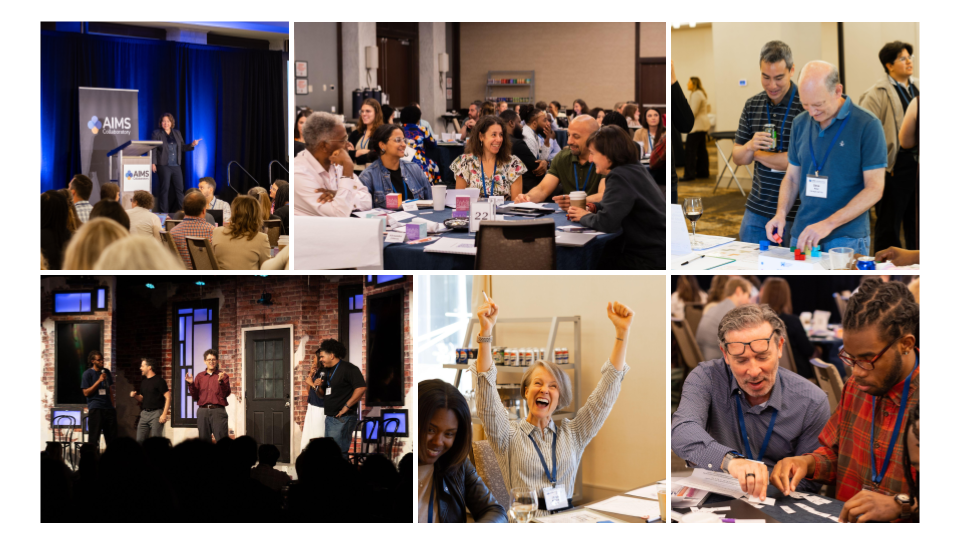
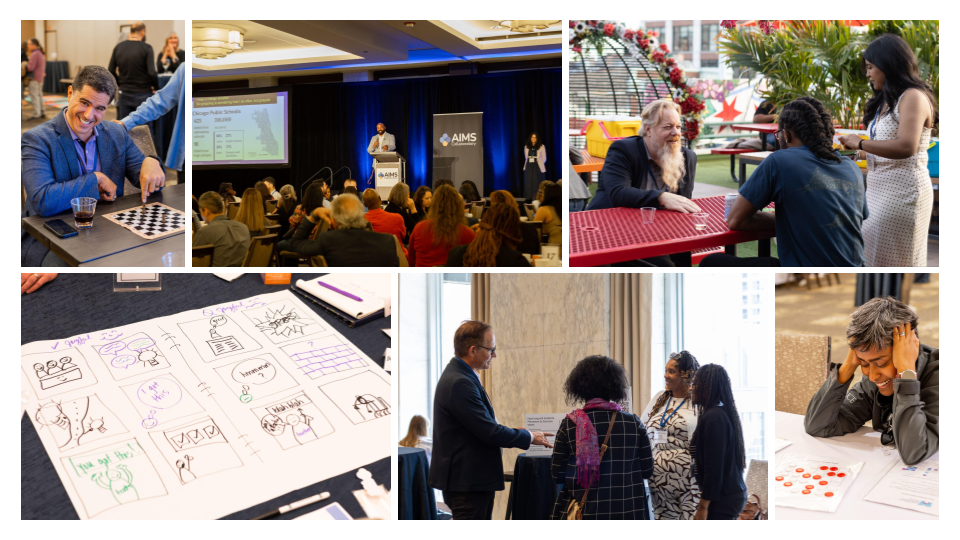
In the world of teaching and learning mathematics, creating joy means fostering the kinds of mathematics experiences that help students persist through rigorous work, rejoice in their accomplishments, and develop positive mathematical identities. In that vein, the convening kicked off with the AIMS Mathematics Festival. In collaboration with Math Circles of Chicago and the Julia Robinson Math Festival, high school students and educators from Chicago Public Schools led participants through hands-on puzzles, games, and challenges, offering a joyful celebration of mathematical problem-solving, curiosity, and discovery.
That experience of doing math together set the stage for the purpose of the gathering. The convening brought together Collaboratory grantees from across the Gates Foundation’s K–12 R&D portfolio, including edtech developers, researchers, classroom educators, district leadership, advisors, and funders. Across two days, participants connected across roles and projects, shared emerging work, explored challenges, and considered what it takes to create more equitable, rigorous, and joyful mathematics learning experiences for students growing up furthest from opportunity.
Sessions reflected the breadth of that work, with participants exploring research-developer-practice partnerships, AI in math education, project storytelling, teacher joy and professional learning, implementation data, and lessons from teams nearing the end of their AIMS journeys. Through plenary sessions, demos, table conversations, a solutions lab, and dedicated collaboration time, the program made visible a progression from experience to meaning-making to application: the mathematics festival created a common experience; plenaries and reflections helped the community name why it mattered; and demos, sessions, and collaboration time created space to test rough-draft thinking and identify opportunities for continued work across teams. For a community doing educational R&D, ideas move from shared experience into tools, materials, research, and practice.
AIMS teams are functioning across research, development, implementation, and practice. Their work depends on evidence and technical capacity, but it also depends on the quality of collaboration: who is in the room, whose expertise is recognized, how ideas are tested, and how teams learn from the realities of classrooms and districts. This is part of what makes an AIMS convening distinct.
Youth were present and active throughout the convening as full participants. Their presence kept the work grounded in the students it is meant to serve, and pushed participants to ask important questions about their approaches to math learning: whether the materials, technologies, and instructional practices they are building create the conditions for authentic student engagement, and whether productive struggle supports understanding, competence, and mathematical identity rather than exclusion.
The theme of joy gave these varied conversations a common thread, as Sarah Lindo, a Youth Advisory participant with BUILD, noted on LinkedIn:
Joy and rigor within math do not cancel each other out. Instead, they co-exist and complement one another. It was an inspiring few days with powerful insights and a chance to advocate for better math education for youth around the country.”
Sarah Lindo
Youth Advisory Participant | BUILD
By the end of the gathering, the convening’s focus on joy had opened a wider lens on rigorous mathematics learning to include belonging, agency, curiosity, identity, and persistence through hard ideas. It also pointed to what can be lost when the experience of mathematics narrows to performance, compliance, speed, or correctness: less room for students to see themselves as capable mathematical thinkers.
The time spent together in Chicago reinforced the premise of the AIMS Collaboratory itself: that better mathematics learning grows from shared inquiry across educators, researchers, developers, and funders, and that the product of the work is stronger when people test emerging ideas, learn across roles, and make sense of hard problems in community.
Photos: Tiffany Clark, Ph.D