
Snorkl
Joined 2026
Partners
Snorkl
WestED
Des Moines Public Schools (IA)
Parkway Schools (MO)
EL Haynes Public Charters (Washington DC)
Twin Rivers Unified (CA)
Birdville ISD (TX)
What are we building?
Snorkl is AI that makes students think more, not less. Intentionally designed by and for teachers, Snorkl was purpose-built to improve understanding, engagement, and instructional decision-making in K–12 classrooms; in particular, for math classes where there is often less focus on discussion.
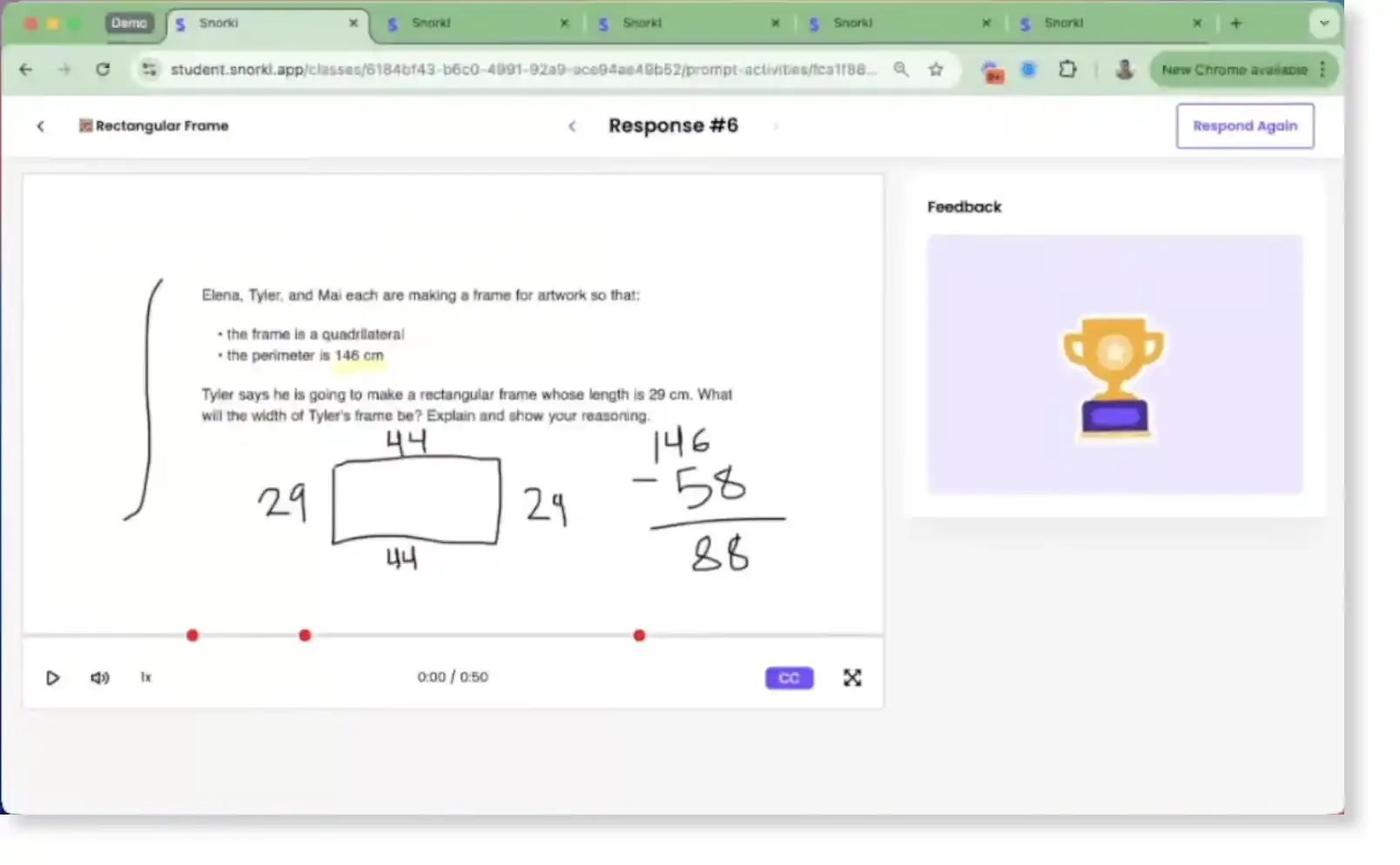
Students speak, draw, upload images, or write to demonstrate their understanding in 65+ languages
Snorkl provides immediate, personalized feedback and support that moves beyond correctness to true understanding—how students reason, where they struggle, and how their ideas develop over time
Teachers get actionable insights and a deeper look at student thinking
Administrators get high-quality, aligned resources and school data snapshots
Based on research and user feedback, these upcoming capabilities extend this core experience:
Multi-Activity Progression: A guided learning pathway that moves students from one activity to the next based on their level of understanding, supporting sustained practice and higher level depth of knowledge over time.
Multi-Activity Teacher Insights: Aggregated qualitative and quantitative insights across activities, helping teachers identify patterns in student thinking (such as highlighting common math misconceptions) to surface discussion questions to drive instruction.
Together, these features create a system that not only supports individual student growth but also strengthens whole-class learning through more responsive teaching.
What are we learning?
Our overarching question is: How does making student thinking visible—and actionable across multiple activities—impact student learning and instructional practice?
Specifically, we aim to learn:
Student Voice and Thinking:
How does attaching student voice to their work, through recorded explanations alongside written or visual responses, impact motivation, engagement, persistence, and depth of understanding? Does it inherently create ownership? How does verbalizing thinking change how students process, refine, and communicate mathematical ideas?
Student Thinking and Feedback:
How does immediate, AI-driven feedback on students’ recorded thinking influence their ability to revise, deepen, and articulate their understanding? Does this encourage natural productive struggle?
Learning Progression:
How does guiding students through sequenced activities based on their sequential understanding impact mastery, persistence, and engagement? Does this improve understanding of the major work of the grade?
Instructional Insight:
How do aggregated insights across multiple activities help teachers better identify misconceptions, track growth, and adjust instruction in real time?
Equity and Access:
How does multimodal input and multilingual feedback support participation and understanding for multilingual learners and students with diverse learning needs?
Products
Snorkl enables students to record their thinking using voice, drawing, and text, making their reasoning visible. The platform provides immediate, specific criteria-aligned AI feedback that focuses on both correctness and the thinking process. Students can revise and resubmit, building understanding through iteration and reflection. With partnerships with curriculum providers, such as IM, Snorkl fits within the context of rigorous HQIM and existing instructional practices and routines.
Multi-Activity Progression
A structured pathway that guides students through a sequence of activities based on their performance. This feature supports continuous practice, reinforces key concepts, and helps students build toward deeper understanding over time without requiring constant teacher direction.
Multi-Activity Teacher Insights
A set of teacher-facing tools that aggregate student performance across activities, combining quantitative data (scores, trends) with qualitative insights (student reasoning, misconceptions). The system highlights patterns in student thinking and generates discussion questions to support in-the-moment and future instruction.